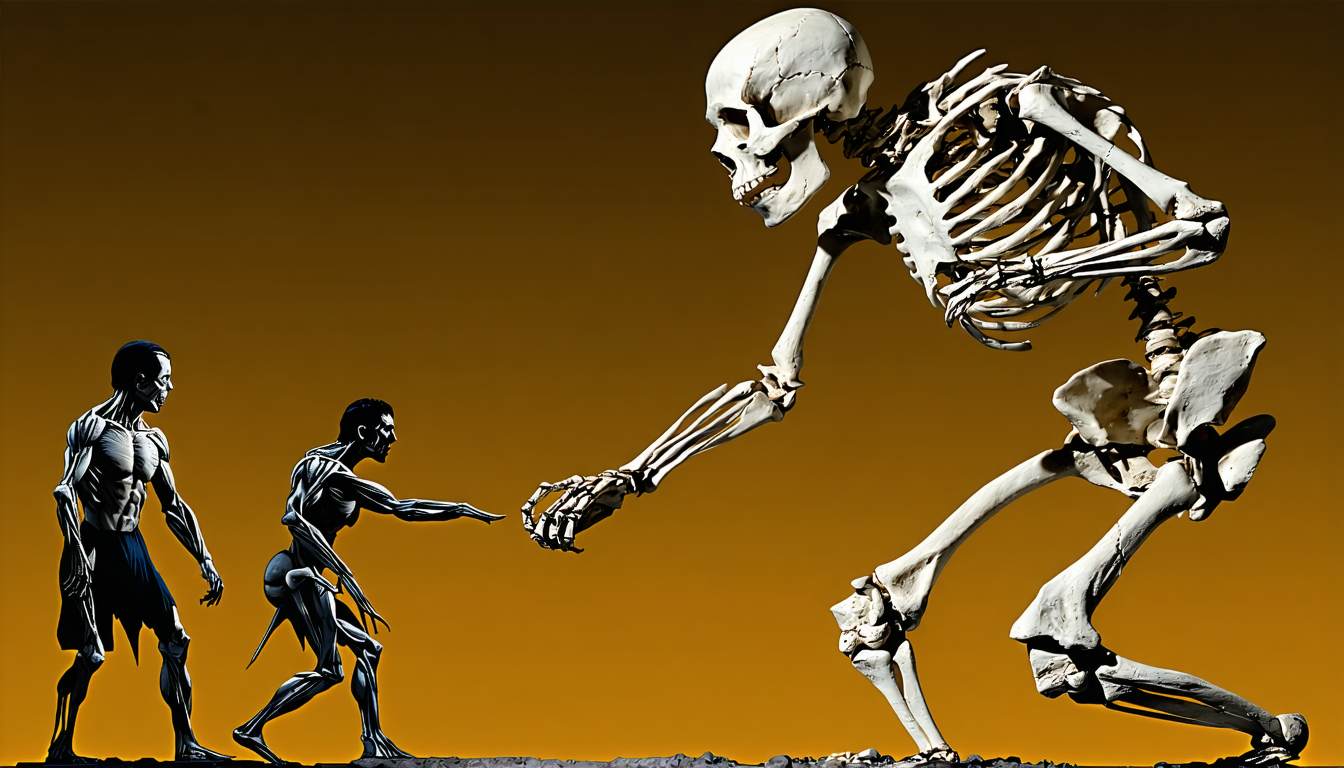
Evidence Suggests Neanderthal Life Involved Frequent Violent Conflicts
🐦 The Peck
Key Facts
-
●
A Neanderthal skeleton was found with a wound that suggests it may have died from a violent encounter.
CORROBORATED -
●
Research indicates that Neanderthals may have engaged in lethal fighting more often than previously thought.
CORROBORATED -
●
The discovery of the wound on the Neanderthal skeleton was made in a site in Europe.
UNVERIFIED -
●
Neanderthals are believed to have lived in social groups that may have led to conflicts over resources.
CORROBORATED
🔍 The Big Picture
The recent discovery of a Neanderthal skeleton exhibiting a wound consistent with a violent encounter underscores a growing body of evidence suggesting that Neanderthals may have experienced frequent violent conflicts. This finding, emerging from archaeological research in Europe, not only enhances our understanding of Neanderthal social dynamics but also raises questions about the nature of human interaction during the prehistoric era. Previous perceptions of Neanderthals as primarily peaceful social groups that cooperated for survival are being challenged by this evidence of lethal fighting, indicating that competition over resources may have been a significant factor in their lives.
This revelation is crucial for several reasons. First, it provides insights into the behavioral patterns of Neanderthals, suggesting that they were not merely primitive relatives of modern humans but complex beings capable of aggression and conflict. Understanding the motivations behind such violence—whether it stemmed from competition for food, territory, or social standing—can inform our broader understanding of social behavior in early hominins. This information is particularly relevant to anthropologists and historians as they construct narratives about human evolution and social structures.
Moreover, the implications extend beyond academic discourse into the realms of public policy and education. As our understanding of early human behavior evolves, there may be a need to revise educational materials and public perceptions regarding Neanderthals and their interactions. This could influence how archaeological findings are presented in museums and educational programs, potentially impacting funding and support for further research in anthropology and archaeology.
Competing interpretations of this evidence exist, with some researchers arguing that instances of violence may have been isolated events rather than indicative of a widespread pattern of behavior. Others caution against drawing definitive conclusions from a single skeleton, emphasizing the need for more comprehensive data to substantiate claims of frequent conflict among Neanderthals. While the current findings are compelling, they also highlight the uncertainties still present in the study of prehistoric life, where much remains speculative.
In summary, the evidence suggesting frequent violent conflicts among Neanderthals not only enriches our understanding of their social structures but also prompts reevaluation of long-held beliefs about early human behavior. As researchers continue to analyze these findings, the broader implications for education, policy, and our understanding of human evolution will likely unfold, reflecting the complex interplay between competition and cooperation that characterizes both our past and present.
👀 What to Watch
- **Publication of Research Findings**: Anticipated release of a peer-reviewed study detailing the findings related to the Neanderthal skeleton and its implications for understanding Neanderthal violence, expected in a scientific journal in early November 2023.
- **Conference Presentation**: Researchers involved in the Neanderthal study are scheduled to present their findings at the European Society for the Study of Human Evolution conference on November 15-17, 2023, in Lisbon, Portugal.
- **Archaeological Excavation Updates**: Ongoing excavations at the site in Europe where the skeleton was found may yield additional findings; updates are expected to be shared by the research team in December 2023.
- **Public Lecture Series**: A series of public lectures on Neanderthal life and social structures, including discussions on violence and conflict, will be hosted by the University of Cambridge, starting on January 10, 2024.
- **Documentary Release**: A documentary exploring the life and conflicts of Neanderthals, featuring insights from the recent findings, is set to premiere on a major streaming platform on February 1, 2024.
Comments (0)
No comments yet. Be the first to share your thoughts!
This Peckture was researched and generated by Peckture.com based on publicly available information. All claims are marked with their verification status.
Last updated: October 15, 2026 5:01 PM