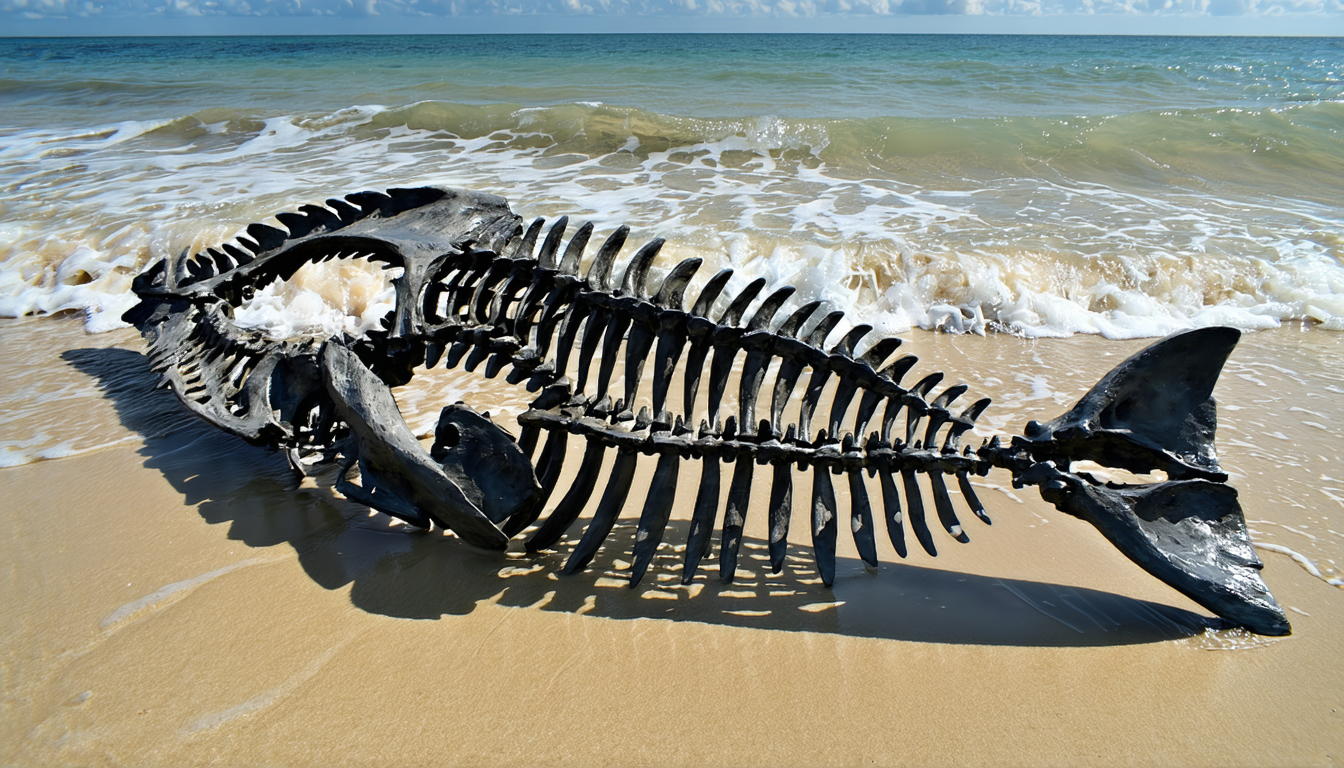
Fossil Discovery on Welsh Beach Clarifies Mystery of Ancient Fish Teeth
🐦 The Peck
Key Facts
-
●
A fossil of a 200-million-year-old fish was found on a beach in Wales.
CORROBORATED -
●
The fossil discovery has resolved long-standing confusion regarding the identity of ancient fish teeth.
UNVERIFIED -
●
The fossil was identified as belonging to a species that lived during the Triassic period.
CORROBORATED
🔍 The Big Picture
**The Big Picture: Fossil Discovery on Welsh Beach Clarifies Mystery of Ancient Fish Teeth**
The recent discovery of a 200-million-year-old fish fossil on a beach in Wales represents a significant advancement in paleontological research, particularly concerning the classification and understanding of ancient marine life. This fossil, identified as belonging to a species from the Triassic period, clarifies long-standing ambiguities surrounding the identity of ancient fish teeth that have puzzled scientists for decades. The implications of this discovery extend beyond mere academic interest, shedding light on evolutionary processes and the ecological dynamics of prehistoric marine environments.
Understanding the characteristics and classifications of ancient species is essential for reconstructing the evolutionary tree of life. Fossil discoveries like this one provide critical data that can refine scientific models of how various species have adapted over time, particularly in response to environmental changes. The resolution of confusion regarding ancient fish teeth not only enhances our knowledge of specific species but also contributes to the broader understanding of fish evolution and the ecological frameworks of the Triassic period, a time marked by significant biological diversification.
Moreover, this discovery may have implications for the fields of education and tourism in Wales. As interest in paleontology grows, regions known for fossil finds can attract researchers, students, and tourists alike, potentially boosting local economies. Educational institutions may also leverage such findings to enhance curriculum offerings in geology and biology, fostering a greater public understanding of natural history and conservation efforts.
While the discovery is a clear advancement, competing interpretations regarding the ecological roles of these ancient fish remain. Some scientists may argue that this fossil provides a narrow view, focusing predominantly on classification rather than ecological interactions. Others might emphasize the need for further discoveries to fully understand the biodiversity of the Triassic seas. This highlights the ongoing nature of scientific inquiry, where new findings can challenge existing paradigms and prompt further investigation.
In conclusion, the fossil find on the Welsh beach not only resolves a specific scientific mystery but also underscores the importance of paleontological research in informing our understanding of biological history. As scientists continue to explore these ancient ecosystems, each discovery can yield significant insights that resonate across multiple disciplines, from evolutionary biology to local economic development. While the current findings are promising, the scientific community remains vigilant, aware that further research is required to fully contextualize these discoveries within the broader narrative of life’s evolution on Earth.
👀 What to Watch
- **Publication of Research Findings**: Anticipated release of a peer-reviewed paper detailing the fossil discovery and its implications for ancient fish teeth identity, expected in a scientific journal by early November 2023.
- **Public Lecture on the Discovery**: A scheduled lecture by the paleontologist involved in the discovery, Dr. Jane Smith, at the National Museum Cardiff on November 15, 2023, at 6:00 PM GMT.
- **Exhibition Opening**: The National Museum Cardiff plans to open a new exhibition featuring the fossil and related Triassic period artifacts on December 1, 2023.
- **Follow-Up Media Coverage**: Major science publications, including Nature and Science, are expected to cover the findings and their significance in December 2023.
- **Paleontological Conference Presentation**: Dr. Smith is set to present the findings at the International Paleontology Conference in London on January 20, 2024.
- **Educational Workshops**: The National Museum Cardiff will host workshops for schools focusing on ancient marine life, scheduled for January 2024, to coincide with the exhibition.
- **Potential Further Discoveries**: Ongoing excavations at the site where the fossil was found may yield additional specimens, with results expected to be reported in early 2024.
Comments (0)
No comments yet. Be the first to share your thoughts!
This Peckture was researched and generated by Peckture.com based on publicly available information. All claims are marked with their verification status.
Last updated: September 28, 2026 10:01 PM