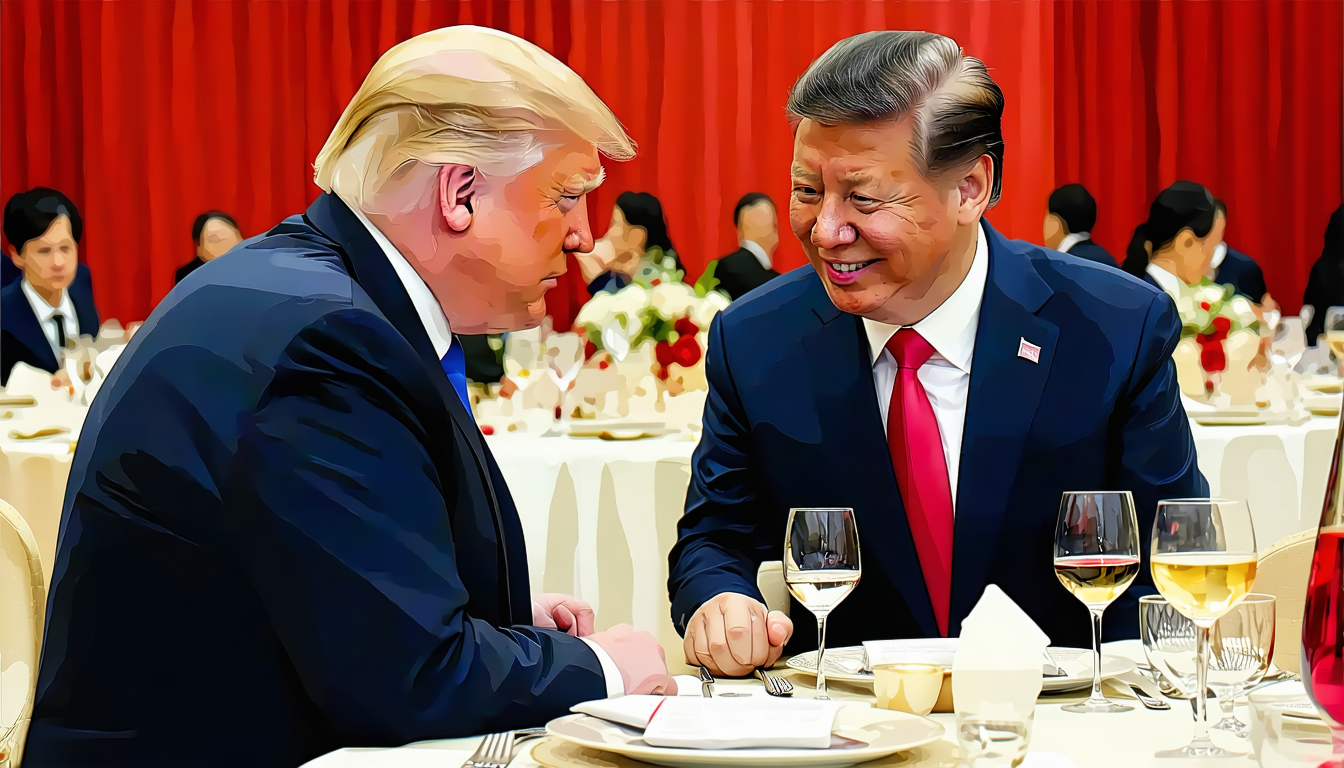
Trump and Xi Discuss Relations at State Dinner Amid Ongoing Tensions
🐦 The Peck
Key Facts
-
●
Trump and Xi exchanged warm remarks during a state dinner.
CORROBORATED -
●
Key issues such as trade, human rights, and military tensions remain unresolved.
CORROBORATED -
●
The dinner was part of ongoing diplomatic efforts between the U.S. and China.
CORROBORATED -
●
Both leaders emphasized the importance of cooperation despite differences.
UNVERIFIED
🔍 The Big Picture
**The Big Picture: Trump and Xi Discuss Relations at State Dinner Amid Ongoing Tensions** The recent state dinner between U.S. President Donald Trump and Chinese President Xi Jinping marks a significant moment in U.S.-China relations, characterized by both cordial exchanges and underlying tensions. The warm remarks exchanged during the dinner signal a desire from both leaders to manage their complex relationship, which has been strained by trade disputes, human rights issues, and military posturing in the Asia-Pacific region. This diplomatic engagement is part of broader efforts to stabilize a relationship that is crucial not only for the two countries but also for global economic and geopolitical stability.
The unresolved issues discussed during the dinner—particularly trade and human rights—highlight the challenges that persist in U.S.-China relations. The trade war initiated between the two nations has had significant ramifications for global markets, affecting supply chains and economic forecasts. Businesses on both sides are keenly observing these developments, as tariffs and trade restrictions can directly impact profitability and market access. Additionally, human rights concerns, particularly regarding Hong Kong and Xinjiang, complicate the narrative, as they introduce ethical considerations that may influence public sentiment and policy decisions in the U.S. and abroad.
The emphasis on cooperation, despite differences, reflects a strategic acknowledgment from both leaders that collaboration is essential for addressing global challenges such as climate change, public health, and regional security. However, the sincerity of this cooperation is subject to interpretation, as previous diplomatic overtures have often been undermined by subsequent actions. The competing narratives surrounding the U.S.-China relationship—whether it is a partnership based on mutual benefit or a rivalry with inherent conflict—will continue to shape policy decisions and international alliances. Looking ahead, the implications of this dinner extend beyond bilateral relations.
For businesses, the potential for easing trade tensions could lead to a more favorable environment for investment and trade flows. Conversely, any deterioration in relations could prompt companies to reassess their strategies in the region. Furthermore, the geopolitical landscape could shift depending on how effectively both leaders navigate their domestic pressures while managing external perceptions, particularly in the context of rising nationalism and protectionism. In summary, while the state dinner serves as a platform for dialogue and potential cooperation, the substantive issues that remain unresolved could lead to further volatility in U.S.-China relations.
This dynamic is crucial for stakeholders across various sectors who must remain vigilant in assessing how these interactions will influence both immediate business outcomes and long-term strategic positioning within the global market.
👀 What to Watch
- **October 30, 2023**: The U.S. Treasury is scheduled to release its semi-annual report on currency manipulation, which may impact trade relations and ongoing negotiations with China.
- **November 8, 2023**: The U.S. House of Representatives is set to hold a hearing on human rights issues in China, focusing on Xinjiang and Hong Kong, which could influence diplomatic discussions.
- **November 15, 2023**: The Asia-Pacific Economic Cooperation (APEC) summit will take place in San Francisco, where both leaders are expected to engage in further discussions on trade and regional security.
- **November 30, 2023**: The deadline for the U.S. to impose additional tariffs on Chinese goods, if negotiations do not yield satisfactory results, could significantly impact trade relations.
- **December 2023**: The U.S. Department of Defense is expected to release its annual report on military and security developments involving China, which may inform future diplomatic strategies.
- **January 2024**: The next round of U.S.-China trade negotiations is anticipated, aiming to address unresolved issues from the recent state dinner discussions.
- **February 2024**: The Biden administration is expected to announce its foreign policy strategy for the Indo-Pacific region, which may include specific measures regarding China relations.
Comments (0)
No comments yet. Be the first to share your thoughts!
This Peckture was researched and generated by Peckture.com based on publicly available information. All claims are marked with their verification status.
Last updated: September 25, 2026 3:13 PM